Progression Step 3:
Progression Step 3 in the Curriculum for Wales numeracy framework typically aligns with ages 8–11 (approx. Years 4–6), focusing on deepening understanding of the number system (decimals, fractions, negative numbers), strengthening algebraic reasoning (patterns and sequences), and applying data handling and statistical skills.
Key Areas of Learning (Progression Step 3):
- Number System (Extending Understanding): Learners work with larger numbers (thousands/hundred thousands), negative values, and fractions, decimals, and percentages.
- Equivalence: Learners understand the relationships between fractions, decimals, and percentages and can calculate them within contexts like money and measures.
- Algebraic Reasoning: Learners identify, copy, and generate complex sequences of numbers and shapes, as well as use algebra to represent structures and patterns.
- Geometry and Measurement: Measuring and calculating with higher precision, including perimeter and area.
- Statistics: Representing data and interpreting probability models to make informed decisions.
Hwb resources for Progression Step 3.
Skills list for Progression Step 3:
The number system:
- I can read and write numbers to 1 million and numbers to 3 decimal places.
- I can use the terms square and square root.
- I can estimate by rounding to the nearest 10, 100, 1000 or whole number.
Relationships within the number system:
- I can use understanding of simple fraction, decimal and percentage equivalences, e.g. find 25% of 60cm and know that this is equivalent to ¼ of 60cm.
- I can simplify a calculation by using fractions in their simplest terms.
- I can use and interpret different representations of fractions, e.g. mixed numbers and improper fractions.
- I can use equivalence of fractions, decimals and percentages to compare proportions.
Calculation:
- I can use mental strategies to recall multiplication tables up to 10 x 10 and use to solve division problems.
- I can multiply numbers and decimals by a multiple of 10, e.g. 15 x 30, 1.4cm x 20.
- I can halve 3-digit numbers in the context of number, money and measures.
- I can calculate a percentage, fraction and decimal of any quantity with a calculator where appropriate.
- I can use ratio and proportion to calculate quantities.
- I can calculate percentage quantities based on 10%, e.g. 20%, 5%, 15%.
- I can add and subtract numbers using whole numbers and decimals.
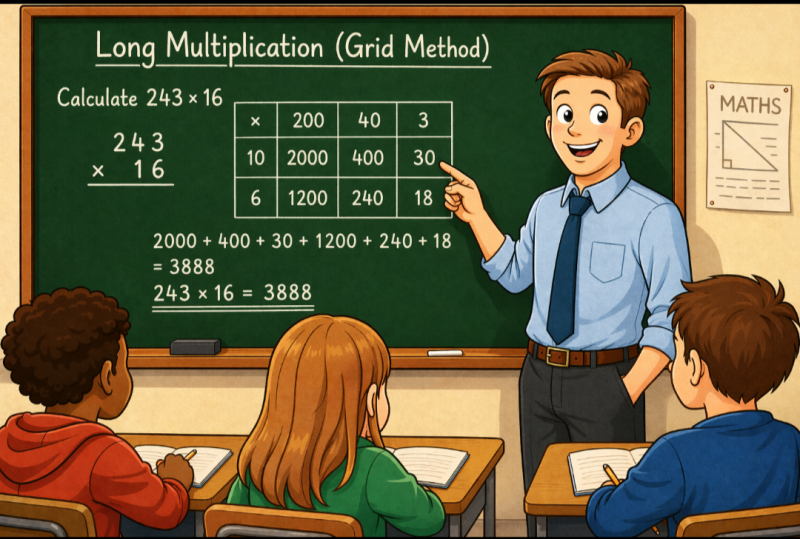
- I can multiply 2- and 3-digit numbers by a 2-digit number.
- I can divide 3-digit numbers by a 2-digit number.
- I can use a range of strategies to check calculations including the use of inverse operations, equivalent calculations and the rules of divisibility.
Financial Literacy:
- I can add and subtract totals less than £100 using correct notation, e.g. £28.18 + £33.45.
- I can manage money, compare costs from different retailers and determine what can be bought within a given budget.
- I can make comparisons between prices and understand which is best value for money.
- I can use profit and loss in buying and selling calculations.
- I can realise that budgeting is important.
- I can understand the advantages and disadvantages of using bank accounts.
- I can plan and track money and savings by keeping accurate records.
Measurement:
- I can read and interpret scales or divisions on a range of measuring instruments.
- I can record measurements in different ways, e.g. 1.3kg = 1kg 300g, 4.2cm = 4cm 2mm.
- I can convert metric units of length to smaller units, e.g. cm to mm, m to cm, km to m.
- I can use the language of imperial units in daily use, e.g. miles, pints.
- I can read and use analogue and digital clocks.
- I can use and interpret calendars, timetables and schedules to plan events and activities, and make calculations as part of the planning journey.
- I can carry out practical activities involving timed events and explain which unit of time is the most appropriate.
- I can time events in minutes and seconds, and order the results.
- I can estimate how long a journey takes.
- I can measure and record temperatures involving positive and negative readings.
Shape and Space:
- I can recognise that perimeter is the distance around a shape.
- I can measure and calculate perimeter.
- I can find areas by counting squares, progressing to calculating the area of squares and rectangles using formulae.
- I can use mathematical language to accurately describe two-dimensional and three-dimensional shapes.
- I can find volumes by counting and other practical methods.
Position:
- I can use grid references to specify location.
- I can use coordinates to find position.
Angle:
- I can use angle as a measure of rotation.
Collecting Data:
- I can collect relevant data to answer posed questions.
Representing Data:
- I can select and construct appropriate charts, diagrams and graphs with suitable scales.
- I can represent data using:
• lists, tally charts, tables, diagrams and frequency tables.
• bar charts, grouped data charts, line graphs and conversion graphs.
• pictograms where one symbol represents more than one unit using a key.
• Venn and Carroll diagrams.
Interpreting Data:
- I can extract and interpret information from an increasing range of diagrams, timetables and graphs (including pie charts).
- I can draw conclusions from data and recognise that some conclusions may be misleading or uncertain.
- I can use mean to interpret a simple data set.
Create Your Own Website With Webador