Progression Step 2:
Progression Step 2 in the Curriculum for Wales Mathematics and Numeracy typically covers learners aged five to eight (roughly Year 1 to Year 3). It focuses on building concrete understanding into abstract reasoning, covering number systems, fractions, decimals, percentages, and early algebra, often using visual representations and games.
Key Areas of Learning (Progression Step 2):
- Number System: Learners can read, write, and order numbers up to at least one million, understand digit value, and use negative values.
- Fractions & Decimals: Students use halves and quarters, understand simple percentages (like 25% or 50%), and convert between fractions, decimals, and percentages.
- Algebraic Reasoning: Learners identify, copy, and create number patterns, use the equals sign to represent balance, and solve missing number problems.
- Mathematical Reasoning: Pupils move from concrete to abstract, using verbal, visual, and symbolic representations to explain their methods.
- Application: Students use these skills to solve problems in real-life contexts, including money and measurements.
Hwb resources for Progression Step 2.
Skills list for Progression Step 2:
The number system:
- I can read, write and interpret numbers using figures and words up to at least 1000.
- I can compare, round and estimate with numbers up to 100.
- I can count in different steps of uniform size, and recognise odd and even numbers.
- I can check subtraction using addition.
- I can check halving using doubling.
Relationships within the number system:
- I can use halves and quarters.
- I can halve 2-digit numbers in the context of number, money and measures.
- I can find fractional quantities linked to known multiplication facts, e.g. 1/3 of 18, 1/5 of 15.
Calculation:
- I can find differences within at least 100.
- I can use mental strategies to add and subtract at least 2-digit numbers.
- I can use partitioning to double and halve 2-digit numbers.
- I can use mental strategies to recall number facts within 20.
- I can recall 2, 3, 4, 5 and 10 multiplication tables and use to solve multiplication and division problems.
- I can multiply numbers by 10.
- I can check multiplication using repeated addition.
Financial Literacy:
- I can use different combinations of money to pay for items up to at least £2 and calculate the change.
- I can order and compare items up to £10.
Measurement:
- I can use non-standard units to measure.
- I can progress to use standard units of measure:
• length: I can measure on a ruler to the nearest 0.5cm
• weight/mass: I can use 5g, 10g and 100g weights to measure and compare the mass of objects
• capacity: I can read scale to to the nearest 100ml.
- I can use the concept of time in terms of my daily and weekly activities and the seasons of the year.
- I can use standard units of time to read ‘o’clock’, ‘half past’, ‘quarter past’ and ‘quarter to’ using both analogue and 12-hour digital clocks.
Shape and Space:
- I can discuss the properties of two-dimensional and three-dimensional shapes that I use in my everyday learning.
Position:
- I can use the language of position.
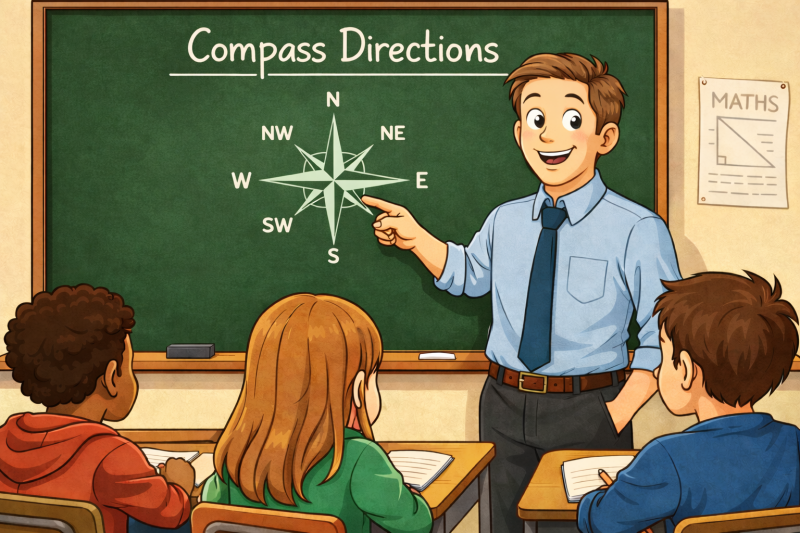
- I can use the four compass points to describe directions.
Angle:
- I can recognise half and quarter turns, clockwise and anti-clockwise.
Collecting Data:
- I can collect information by voting or sorting.
Representing Data:
- I can sort and classify objects using more than one criterion.
- I can present work orally, in objects, pictorially and in written form, and use a variety of ways to represent collected data with suitable scales including:
• lists, tally charts, tables and diagrams.
• bar charts and bar line graphs labelled in 2s, 5s and 10s.
• pictograms where one symbol represents more than one unit using a key.
• Venn and Carroll diagrams.
Interpreting Data:
- I can extract and interpret information presented in charts, timetables, diagrams and graphs.
- I can draw conclusions from data and recognise that some conclusions may be misleading or uncertain.
Create Your Own Website With Webador